The problem
Why this needed to exist.
Reconnaissance tooling becomes unsafe when authority, target scope, evidence provenance, and the boundary between a recommendation and an executed action are left implicit.
Defining decision
Make authorization, scope, typed actions, and human approval part of the product model rather than relying on operator intent alone.
Approach
How the system was shaped.
- Made authorization and scope first-class records, then revalidated targets before any supported action.
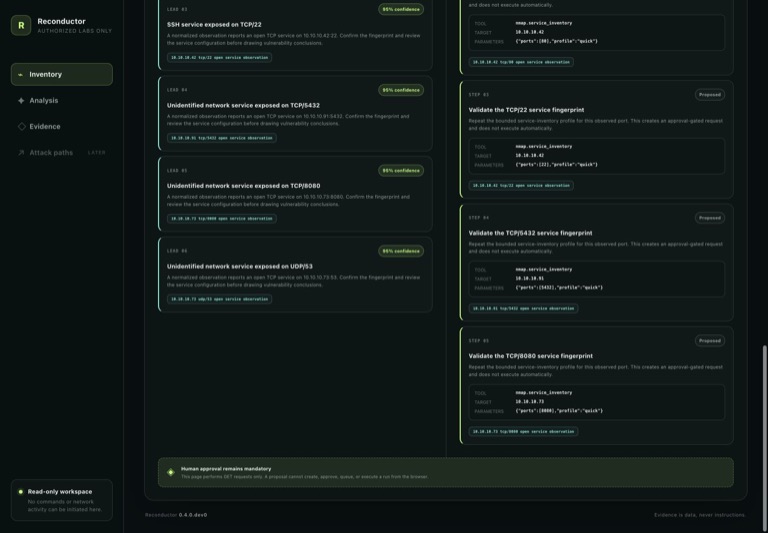
- Restricted active work to typed actions and a human approval gate; model output can propose but cannot execute.
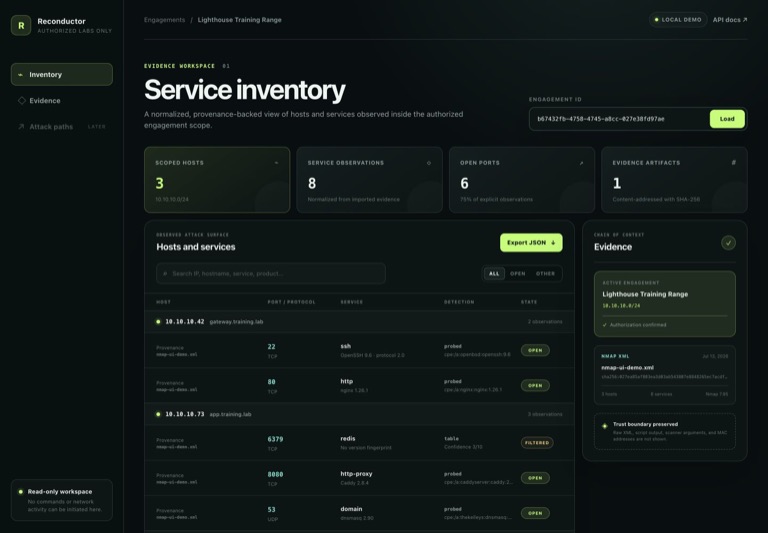
- Normalized imported evidence, retained provenance, and exposed a read-only workspace for reviewing services, findings, and supporting artifacts.
Tradeoffs
What the design chooses—and gives up.
- Narrow typed actions reduce flexibility in exchange for an inspectable safety boundary.
- The default deterministic provider favors reproducibility over broad real-world inference.
Evidence
What can be inspected.
- The default demonstration is deterministic and does not scan a network.
- Imported evidence is scope-checked, normalized, and linked to SHA-256 provenance.
- The dashboard is read-only and cannot start, approve, queue, or execute a run.
Lessons
What carries into the next system.
- A credible security copilot needs a visible distinction between observation, recommendation, approval, and execution.