The problem
Why this needed to exist.
Security guidance becomes more useful when a reviewer can see the control in request behavior, application code, tests, response headers, and a concise interface rather than in a checklist alone.
Defining decision
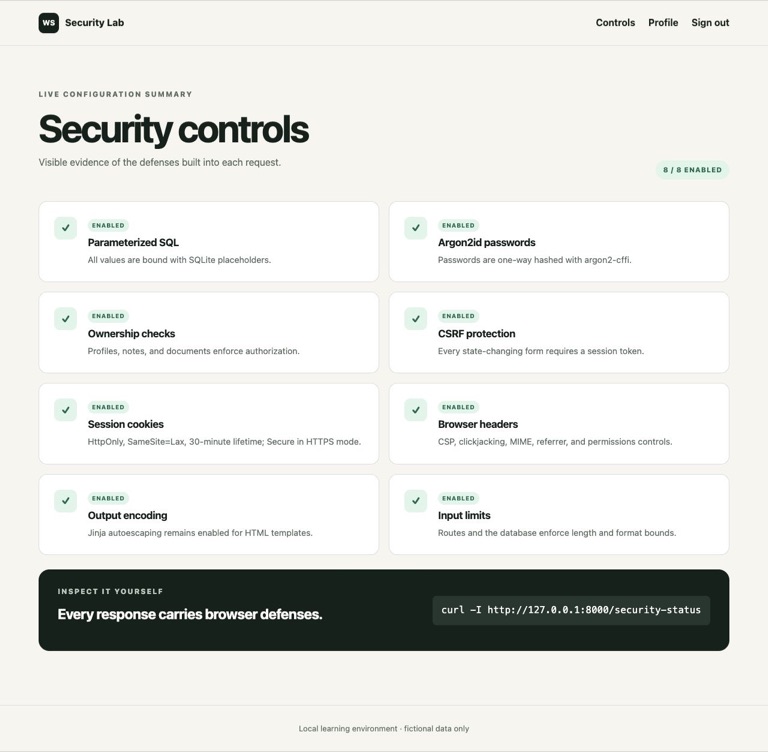
Make controls visible in request behavior, application code, tests, response headers, and the interface instead of describing them only in a checklist.
Approach
How the system was shaped.
- Centralized request and response controls while keeping authorization decisions close to each route.
- Used parameterized SQL, Argon2id passwords, CSRF tokens, scoped access checks, allowlisted downloads, input limits, and browser security headers.
- Added HTTP probes and tests so controls can be inspected outside the interface.
Tradeoffs
What the design chooses—and gives up.
- A small SQLite-backed application keeps the controls legible while excluding production identity, key management, and deployment architecture.
Evidence
What can be inspected.
- The security-status page exposes eight enabled control families with concise implementation notes.
- The project includes coverage, lint, and HTTP-probe workflows.
Lessons
What carries into the next system.
- Security controls are easier to evaluate when behavior, tests, headers, and the interface tell the same story.