Quick read
The story in under a minute.
- Context
- How I prospected nationally, qualified inbound and outbound buyers, explained approved materials, routed technical questions, and coordinated meetings that advanced multiple offers and letters of intent for a 2,822-acre land opportunity.
- My role
- As a Land Broker and the firm’s Ranch Specialist, I served as a named marketing contact for Spurlock Ranch inquiries, conducted direct buyer prospecting, responded to inbound interest generated by the listing and signage, qualified organizations and decision-makers, ran discovery, explained approved public and marketing materials, captured unresolved questions, coordinated meetings, followed up with stakeholders, and supported offers and letters of intent through negotiation. I did not author the original plan, engineering, legal work, surveys, appraisals, municipal approvals, or later North Star Ranch development work.
- Published outcome
- The outcome was not a personally closed sale. The listing team received qualified buyer engagement, multiple offer letters and LOIs. My contribution was to create and qualify buyer interest, communicate the approved opportunity, route questions to the right authority, coordinate meetings, and preserve momentum through follow-up. The defensible broader role statement is that I advanced multi-million-dollar land opportunities and negotiations—not that I closed the property or produced its later approvals or development plan.
- Evidence
- Public project context + archived role context + firsthand commercial activity + strict attribution boundary
Situation
A 2,822-acre opportunity required more than acreage and a listing story.
Spurlock Ranch was a large, long-horizon land opportunity in the Buckeye area. A public 2007 Community Master Plan Amendment describes approximately 2,822 gross acres and 7,329 proposed dwelling units across residential, commerce-park, school, park, and public-use categories, along with circulation, drainage, water, wastewater, adjacent ownership, zoning, and site constraints. I had attended family, legal, engineering, listing-side, and public meetings as an observer before my professional role. My professional involvement began later, when Land Advisors recruited me and then offered me a brokerage position.
Constraint
Qualification, technical scope, long timelines, and distributed authority shaped every next step.
A prospective buyer could not evaluate the opportunity from acreage and price alone. Capital capacity, development fit, planning history, land-use concepts, access, utilities, water and wastewater planning, infrastructure, entitlements, timing, diligence, and decision authority all mattered. The listing and technical teams also could not spend significant time with every caller, so I had to qualify interest before convening deeper meetings while avoiding legal, engineering, planning, appraisal, or municipal conclusions outside my role.
Responsibility
I owned prospecting, inquiry qualification, approved-material explanation, meeting coordination, and follow-through.
As a Land Broker and the firm’s Ranch Specialist, I served as a named marketing contact for Spurlock Ranch inquiries, conducted direct buyer prospecting, responded to inbound interest generated by the listing and signage, qualified organizations and decision-makers, ran discovery, explained approved public and marketing materials, captured unresolved questions, coordinated meetings, followed up with stakeholders, and supported offers and letters of intent through negotiation. I did not author the original plan, engineering, legal work, surveys, appraisals, municipal approvals, or later North Star Ranch development work.
Key decisions
The choices that protected technical boundaries and focused attention on qualified buyers.
- I built the buyer universe around capital capacity, land strategy, geography, development type, and likely fit rather than treating every inquiry as equally qualified.
- I researched the organization and decision-maker before outreach and used the first conversation for qualification and discovery—not as a substitute for technical diligence.
- I used only approved materials to explain scale, planning units, land-use concepts, access, utilities, documented constraints, and regional context.
- I separated questions I could answer from matters that belonged to the listing broker, owners, counsel, engineers, planners, municipalities, or other specialists.
- I coordinated a deeper meeting only after the prospect’s capacity, intended use, authority, timeline, risk tolerance, and next decision were sufficiently clear.
- I tracked unanswered questions, follow-up, offer terms, and LOI status so long-cycle opportunities did not lose momentum between stakeholders.
Approach
I moved from buyer research to qualification, stakeholder routing, and offer or LOI follow-through.
- I used direct research, owner and buyer networks, telephone prospecting, and the property’s marketing exposure to identify potential acquirers.
- For inbound inquiries, I clarified the caller’s organization, capital source, intended use, decision authority, development experience, timing, and acquisition structure before advancing the conversation.
- I walked qualified prospects through approved materials such as the conceptual land-use plan, planning-unit structure, regional context, adjacent ownership, circulation, water, wastewater, and opportunities-and-constraints exhibits.
- I documented technical, legal, entitlement, infrastructure, and financial questions and routed each one to the stakeholder with the appropriate authority and professional scope.
- I coordinated and attended meetings involving ownership, sales, legal, engineering, municipal, investor, and developer participants, then captured the next decision and follow-up owner.
- I conducted targeted outreach to nationally prominent investors and land buyers; one such effort led to a direct meeting, but I omit the individual’s identity because independent corroboration is not retained.
- I supported multiple offer letters and LOIs as opportunities moved into negotiation. One later offer was discussed at approximately $50,000 per acre, but I do not convert that figure into a transaction total because the covered acreage and final structure are not documented.
Collaboration
Each participant supplied different information and retained different decision rights.
Ownership and family stakeholders held the property history and long-term decisions; the listing and advisory team owned market positioning and negotiation strategy; buyers and investors controlled capital and acquisition decisions; and attorneys, engineers, planners, municipalities, and other technical professionals owned their conclusions. I qualified interest, organized the buyer’s questions, coordinated the relevant people, and maintained the commercial follow-through without claiming authority that belonged elsewhere.
Outcome
The work advanced multi-million-dollar land opportunities, offers, and negotiations.
The outcome was not a personally closed sale. The listing team received qualified buyer engagement, multiple offer letters and LOIs. My contribution was to create and qualify buyer interest, communicate the approved opportunity, route questions to the right authority, coordinate meetings, and preserve momentum through follow-up. The defensible broader role statement is that I advanced multi-million-dollar land opportunities and negotiations—not that I closed the property or produced its later approvals or development plan.
Evidence exhibits
Surviving artifacts with visible provenance.
Attribution timeline
My commercial assignment sat inside a much longer project history.
The public plan, archived employer biography, and firsthand account establish different parts of the history and must not be collapsed into one claim.
- 2005–2007 planning work
- Public documents identify the original owners, counsel, project manager, planning, engineering, landscape, and market advisers. I am not listed as an original project-team author.
- Land Advisors · 2013–2015
- I served as Land Broker and Ranch Specialist, handled marketing inquiries, prospected buyers, qualified interest, explained approved materials, coordinated meetings, and supported offers and LOIs.
- Later ownership and North Star Ranch work
- Subsequent public records concern later ownership, approvals, engineering, entitlements, and development plans outside my 2013–2015 role.
Retrospective stakeholder map
I kept commercial coordination separate from decision authority.
A qualified opportunity still required the right question to reach the person authorized and professionally equipped to answer it.
- Ownership and family
- Property priorities, history, and long-term decisions
- Listing and advisory team
- Market positioning, prospecting, qualification, meetings, follow-up, offers, and negotiation support
- Developers and investors
- Feasibility, acquisition, capital, and delivery decisions
- Public and technical stakeholders
- Planning, entitlements, infrastructure, engineering, and public process
Retrospective reconstruction created in 2026 from surviving records and firsthand recollection.
Retrospective commercial workflow
I moved an inquiry from interest to a decision-ready conversation.
The sequence reflects the firsthand work described in this case while omitting identities, private offers, internal systems, and proprietary materials.
- Build the buyer universeResearch capital capacity, geography, strategy, development type, organization, and likely fit
- Qualify the interestClarify entity, authority, intended use, capital, timing, experience, and risk tolerance
- Explain the approved opportunityUse public and approved materials for scale, planning units, land use, access, utilities, and constraints
- Route the diligenceCapture legal, engineering, planning, municipal, ownership, and financial questions for the right owner
- Advance the decisionCoordinate meetings, document next actions, follow up, and support offer or LOI movement
Retrospective reconstruction created in 2026 from surviving records and firsthand recollection.
How this case is documented
How project scale, my commercial role, the negotiations, and later project history are documented separately.
- The 2007 public plan establishes project scale, land-use concepts, the original project team, and documented site context. It does not establish my authorship or responsibility for the 2005–2007 planning work.
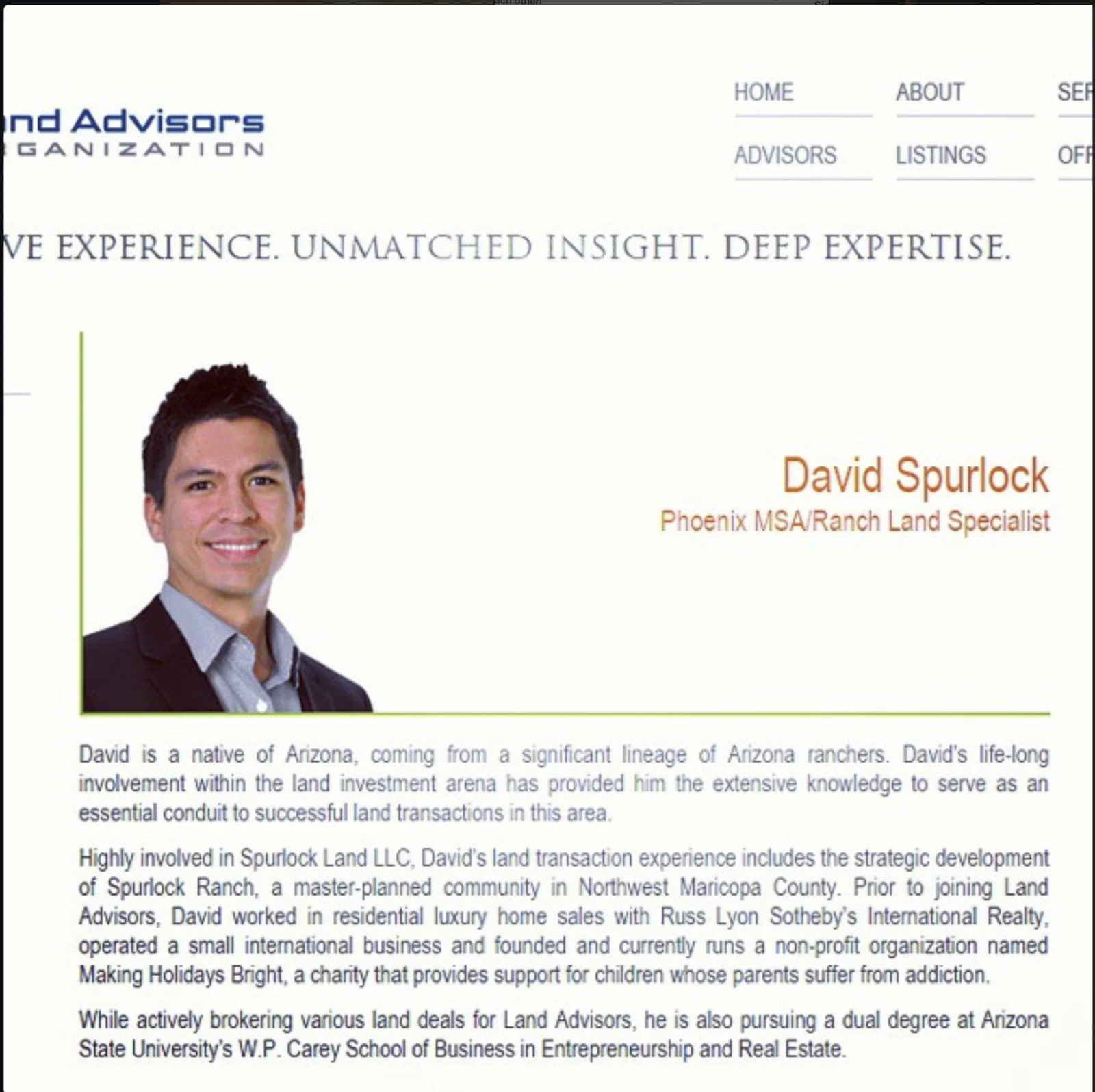
- An archived Land Advisors biography identifies me as a Phoenix MSA / Ranch Land Specialist and describes my historical association with Spurlock Ranch.
- My named inquiry role, national prospecting, buyer qualification, meeting coordination, multiple offers and LOIs, and the approximately $50,000-per-acre discussion are firsthand recollection.
- The approximately $50,000 figure is not multiplied by the full 2,822 acres because the exact parcel, covered acreage, contingencies, and final structure are not documented; no closing is claimed.
- Later North Star Ranch records explain project lineage only. They are not evidence that I owned, authored, engineered, entitled, approved, or developed the later project.
- The Arizona Department of Real Estate record documents historical licensing and brokerage employment, not an active license.
- No buyer identity, private offer, LOI, family deliberation, commission term, valuation assumption, internal note, or proprietary Land Advisors material is published.
Sources and context
- Arizona Department of Real Estate license history — Official historical license and brokerage-employment record. The license is not presented as active.
- Archived Land Advisors biography — Historical employer artifact identifying my role and earlier Spurlock Ranch association.
- City of Buckeye North Star Ranch planning packet — Later project and regional context only; it does not establish my involvement in later approvals or development work.
Lessons
What long-cycle land work taught me about qualification, scope, and attribution.
- Complex opportunities advance when information is organized around who must decide what next—not when every prospect receives every available document.
- Qualification protects both the buyer’s time and the technical team’s capacity.
- Commercial coordination requires knowing when to explain an approved fact, when to surface an unknown, and when to route the question to a licensed or technical owner.
- Clear attribution is essential when a property’s history extends years before and after one person’s professional role.